Honoring Our Roots
Explore whether Southern Oregon's timber economy can support responsible, lower-carbon mass-timber construction backed by verified sourcing and whole-life assessment.
An open-source regenerative urban blueprint for Southern Oregon
An aspirational vision for Medford's economic and ecological future.
Welcome to the blueprint
This website is not a formal City proposal, nor does it represent an executed institutional or corporate partnership. It is a grassroots, turnkey blueprint designed to spark an urgent, evidence-led conversation about the future of Medford's urban core.
The concepts explored here—from a mass-timber stadium district to an applied clean-tech research park—ask how underused downtown and South Medford sites might become year-round engines of regional pride, economic opportunity, and climate resilience.
This is a vision for a net-positive, regenerative Rogue Valley—published openly so the assumptions can be tested.
Why this? Why now?
Explore whether Southern Oregon's timber economy can support responsible, lower-carbon mass-timber construction backed by verified sourcing and whole-life assessment.
Study civic buildings that can offer filtered-air refuge during smoke events, while strengthening everyday energy, water, and emergency resilience.
Design a real training-to-employment pathway with Rogue Community College, trades, employers, and students—subject to those partners choosing to participate.
The regional systems view
Housing, water, mobility, wildfire resilience, workforce, energy, downtown vitality, and capital are not separate problems. The blueprint treats them as one regional ecosystem whose parts must be planned, financed, sequenced, and measured together.
Illustrative Rogue Valley landscape—not a geographic, parcel, or development rendering.
The infrastructure spine
Select a node to review its candidate role, core system, and sequencing logic. This is a conceptual study—not a parcel, ownership, route, or alignment survey.
Concept Study Areas
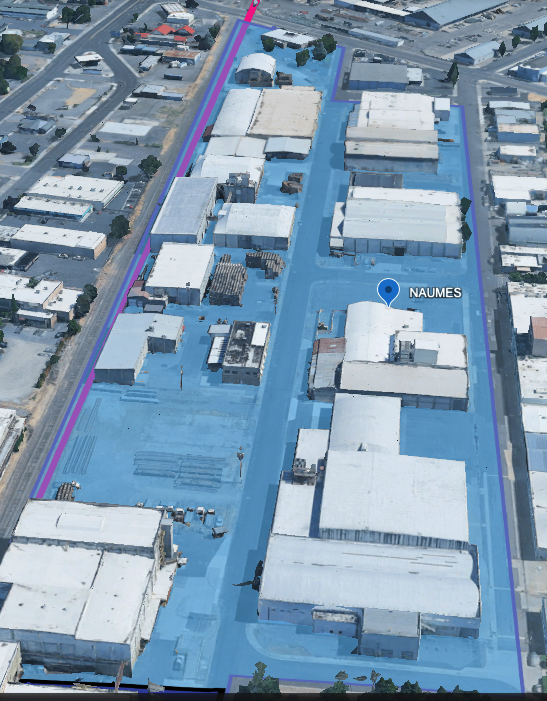
These planning overlays make the thesis tangible at three scales. Boundaries and labels are approximate; they do not establish property control, zoning, transit commitments, or public approval.
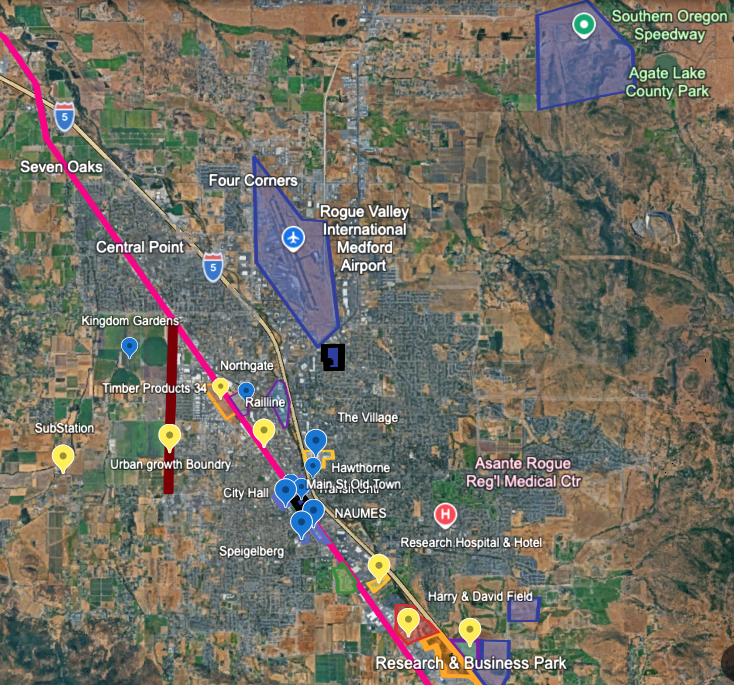
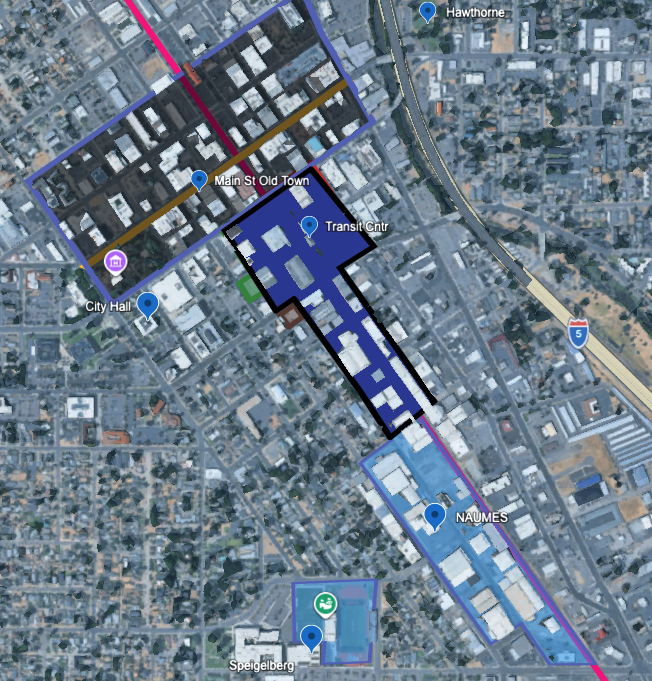
The Rogue Valley H2-Line
The concept explores a quiet north–south rail connection from the McAndrews corridor through downtown to South Medford. Alignment, ridership, right-of-way, technology, safety, lifecycle emissions, capital cost, and operating viability all remain open for comparative study.
North → South · illustrative sequence
McAndrews corridor · candidate commercial and commuter connection
Fir & Grape streets · proposed mass-timber, employment, and public-realm district
Study a direct transfer with existing RVTD regional bus service; no agency commitment is implied
Harry & David Field / proposed Research Park · candidate education, research, and workforce connection
Technology screen
A hydrogen fuel cell can generate electricity onboard while a traction battery captures regenerative-braking energy and supports acceleration. At the vehicle, the electrochemical process produces water and heat; full climate performance depends on how hydrogen is produced, compressed, delivered, and stored.
JR East's HYBARI is a development test vehicle created with Hitachi and Toyota. It demonstrates a fuel-cell/battery rail architecture; it does not validate a Medford route, cost, ridership case, or hydrogen supply chain.
Toyota technical release ↗Hitachi system overview ↗RVTD network ↗
Concept boundary: “H2-Line” names a corridor study, not a selected mode, funded project, adopted alignment, or partnership with Toyota, JR East, Hitachi, RVTD, the City of Medford, or ODOT.
The Four Pillars of the Master Plan
The framework asks whether civic development can restore ecological capacity while improving long-term operating resilience. Every target remains a hypothesis until it is engineered, costed, permitted, commissioned, and measured.
Mass-Timber Eco-Stadium (Node 1) is a candidate civic anchor built around regional cross-laminated timber (CLT), material efficiency, and reversible connections. Whole-building life-cycle assessment, responsible sourcing, fire and seismic design, and end-of-life planning would determine whether the project can meet a verified carbon-storage target.
At the Convention Center Block (Node 3), a “Sponge City” approach could replace impervious pavement with planted capture areas, filtration, and subsurface storage. Capacity and reuse targets would be set only after site hydrology, water-quality, geotechnical, and maintenance studies.
The Transit Corridor (Node 5B) is reserved for a zero-emission mobility study. Hydrogen produced from surplus renewable power is one candidate pathway—not a predetermined technology—and would require independent lifecycle, safety, water, cost, and transit-demand evaluation alongside battery-electric options.
From the Jackson County Sports Park (Node 10A) to the Clean-Tech Research Campus (Node 8), monitored pilots could test soil and runoff remediation methods. Baseline sampling, controlled trials, and third-party verification would come before any claim of contaminant removal or watershed benefit.
Infrastructure Capital
The proposed Regenerative Finance Framework treats energy, water, storage, shared utilities, and productive landscapes as measurable infrastructure layers rather than decorative add-ons. If performance and revenue can be independently validated, portions may support specialized grants, climate finance, utility programs, or private infrastructure investment.
No capital stack is risk-free. Any delivery model would require transparent lifecycle costs, public-benefit terms, legal and credit review, competitive procurement, and clearly allocated downside risk. The 15%–30% range is an early scenario target to test—not an estimate of savings and not evidence that the plan pays for itself.
From vision to underwriting
CitySmart is the regenerative-city financial underwriting workspace inside STRATOS. The Medford Alpha translates an integrated district vision into explicit alternatives, constraints, development layers, funding sources, partner roles, evidence requirements, and phase gates.
Define outcomes across the whole ecosystem.
Expose infrastructure constraints and interfaces.
Name the evidence required before capital advances.
Match each financeable layer to suitable sources.
Compare alternatives, tradeoffs, roles, and next actions.
Use boundary: CitySmart provides scenario modeling and decision support. It is not financial advice, a lender commitment, an investment offering, or a municipal endorsement. Outputs remain illustrative until independently underwritten and approved by the responsible parties.
Municipal Evaluation Matrix
| Strategic Vector | Conventional Baseline | Regenerative District Framework | Potential Economic & Municipal Impact |
|---|---|---|---|
| Material Footprint | Conventional concrete and structural-steel systems with substantial embodied impacts. | Regional mass timber and hybrid systems evaluated through whole-building life-cycle assessment. | Could strengthen regional supply chains and lower embodied carbon if sourcing and design targets are verified. |
| Water Infrastructure | Impervious parking runoff routed into conventional stormwater infrastructure. | Distributed capture, filtration, infiltration, and fit-for-purpose reuse sized to site conditions. | Could reduce peak runoff and potable-water demand; performance depends on engineering and maintenance. |
| Energy Architecture | Passive grid consumption with exposure to peak-hour demand. | Solar, storage, efficiency, and district controls modeled as an integrated system. | Potential operating savings and grid services require utility approval and bankable performance data. |
| Transit Connectivity | Car-dominant surface parking and fragmented pedestrian access. | A multimodal corridor coordinated with existing regional transit and active transportation. | Could expand access and reduce vehicle demand; routes and technologies remain open for study. |
| Capital Stack | Public debt and conventional project finance considered independently. | A blended, phased capital plan tied to verified infrastructure performance. | May limit public exposure, but no financing structure can eliminate project or taxpayer risk. |
Proposed Workforce Pipeline
The proposed charter is a non-binding starting point for discussion. It identifies candidate apprenticeship and early-career participation targets, but creates no obligation for Rogue Community College, the City of Medford, labor, employers, or developers.
Read the proposed charter ↗CLT assembly, moisture monitoring, precision fabrication, building-envelope fundamentals, and structural telemetry.
Photovoltaic operations, electrical safety, battery systems, controls, and monitored load management.
High-performance HVAC, filtered-air operations, water-system controls, sensors, commissioning, and maintenance.
Public Research Library
These papers set out the systems framework, design precedents, study areas, delivery gates, and proposed workforce model. They are published for scrutiny—not as municipal findings, executed agreements, or investment materials.
A Systems Framework for Regenerative Community Development in Tier-3 Cities
The foundational systems paper behind the Rogue Valley concept: landscape institutions, distributed energy infrastructure, living laboratories, mixed-use development, and sports-anchored districts organized as one regenerative operating model.
Sustainability Becomes Infrastructure—Expanding the Capital Stack
A concise case for translating energy, landscape, and digital-system performance into operating stability, financing capacity, new infrastructure capital, and long-term community benefit.
A 365-day civic anchor with staged evidence gates
A disciplined path from precedent review and whole-life carbon targets through site validation, concept design, procurement, commissioning, and public performance reporting.
Three study areas, one connected infrastructure thesis
A visual field guide to the regional spine, downtown civic hub, and South Campus—presented as approximate concept overlays, not parcel, ownership, zoning, or approval maps.
A non-binding framework for local training and opportunity
Candidate apprenticeship, staffing, curriculum, measurement, and governance terms for discussion with Rogue Community College, employers, labor, and public agencies.
Research status: These materials present working frameworks and illustrative modeling—not municipal findings, financing commitments, engineering certifications, institutional endorsements, or investment forecasts. All assumptions and projected outcomes require independent diligence.
Open Model 01
The supplied 3,880.41 MWh annual scenario is distributed across seasonal weights to make the arithmetic reviewable. It is not measured production or a site-specific generation forecast.
months = ["Jan", "Feb", "Mar", "Apr", "May", "Jun",
          "Jul", "Aug", "Sep", "Oct", "Nov", "Dec"]
solar_weights = [0.4, 0.6, 0.9, 1.3, 1.6, 1.8,
                 2.0, 1.8, 1.4, 0.9, 0.5, 0.3]

total_mwh = 3880.41  # illustrative annual scenario
weight_total = sum(solar_weights)
monthly_mwh = [weight / weight_total * total_mwh
               for weight in solar_weights]

for month, value in zip(months, monthly_mwh):
print(f"| {month} | {value:.2f} MWh |")| Month | Illustrative allocation |
|---|---|
| Jan | 114.98 MWh |
| Feb | 172.46 MWh |
| Mar | 258.69 MWh |
| Apr | 373.67 MWh |
| May | 459.90 MWh |
| Jun | 517.39 MWh |
| Jul | 574.88 MWh |
| Aug | 517.39 MWh |
| Sep | 402.41 MWh |
| Oct | 258.69 MWh |
| Nov | 143.72 MWh |
| Dec | 86.23 MWh |
| Total | 3,880.41 MWh |
Model boundary: This seasonal allocation does not include system size, module type, tilt, azimuth, shading, weather-year data, losses, interconnection limits, storage dispatch, or load matching. A public energy claim would require a site-specific engineering model and independent review.
Development status
This platform presents a community-authored concept master plan and proposed performance targets. It is not an adopted City plan and does not imply endorsement by the City of Medford, Rogue Community College, property owners, transit providers, utilities, or any other named institution. All sites, systems, costs, savings, delivery structures, and environmental outcomes remain subject to property rights, engineering and environmental studies, partner agreements, utility coordination, financial underwriting, regulatory approvals, and public review.